Do you need a permit for a driveway in Los Angeles?
In Los Angeles, a private-property driveway slab 30 inches or less above grade needs no building permit. The driveway approach across the sidewalk sits in the public right of way, and needs a Bureau of Engineering A-Permit.
Where your property ends and the city street starts
The public right of way covers the street, the parkway strip and the sidewalk in front of your house. Construction inside that strip is Bureau of Engineering work. Everything behind the property line is your lot, where LADBS handles building and zoning.
One job often sits on both sides of that line. The driveway permit question starts there. The slab and its borders are private work. The apron, the curb cut and the sidewalk crossing belong to the city.
We measure both parts at the estimate for driveway builds and replacements. The permit gets priced before the demo starts.
Does the slab on your own property need a permit?
Usually not. The building code exempts platforms, walks and driveways not more than 30 inches above grade. The exemption holds only when the slab is not over a basement or a story below. Los Angeles County answers the same question the same way.
No permit is not the same as no rules. An access driveway in single-family zones has to be at least 9 feet wide. Driveway slope may not exceed 20 percent.
Not more than 50 percent of a required front yard can be used for access driveways. Front yard parking needs LADBS approval too.
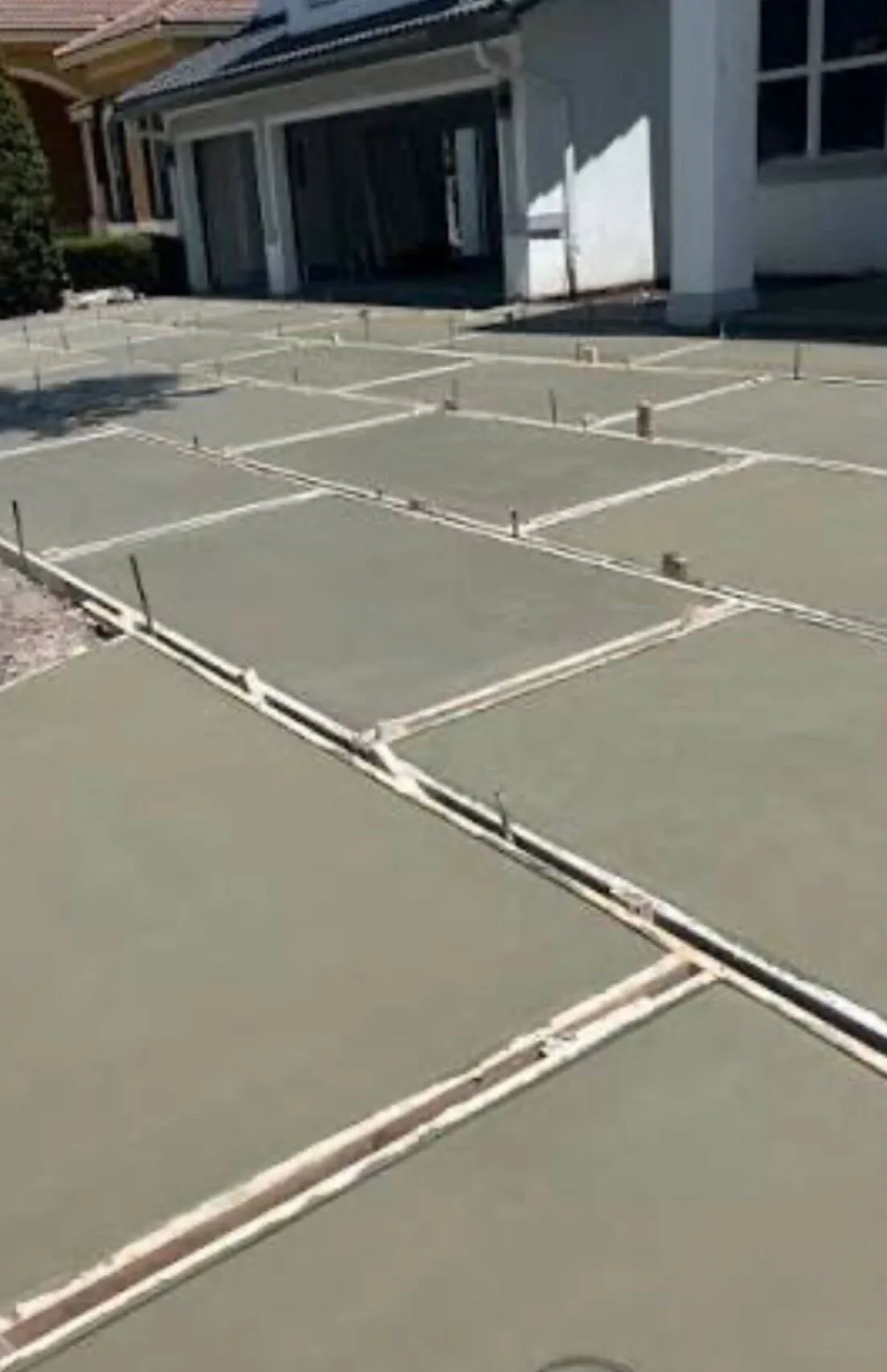
Zoning also sets the surface for a required parking area and its driveway. Asphalt goes at least two inches thick. Portland cement goes at least three inches thick. LADBS can accept an equal material, and our concrete slabs and flatwork get built to those numbers either way.
Two things pull a driveway back into LADBS. A hillside drive usually brings cut and fill, plus a wall along one edge. The wall is its own question, answered in our when a wall needs a permit guide.
Drainage follows the same path. LADBS decides at plan check whether a building or grading permit needs a Low Impact Development clearance.
The approach, the apron and the curb cut
LAMC 62.105 requires a permit for construction in the public right of way, and the A-Permit is that permit. It covers new driveway installation and repair, sidewalk installation and repair, plus curb and gutter repair. A new front walk that crosses the parkway runs on the same permit. That is why some front walkways and entry steps jobs carry one.
City standards come with it. A standard approach is built to City Standard Plan S-440-4. In single-family zones the apron runs at least 10 feet and no more than 18 feet along the curb. A wider one needs a written deviation.
An approach also cannot sit within 5 feet of an existing street light. Old driveways that are abandoned and no longer in use must come out. They go back as full-height curb and sidewalk.
Which office handles which part of the driveway
Which driveway permit applies comes down to where the concrete sits. Most home jobs land in the first two rows.
| Where the work sits | Who issues the permit | What sets it off | Source |
|---|---|---|---|
| Driveway slab on your lot | No LADBS building permit | Slab not more than 30 inches above grade, not over a basement | LAMC 91.106.2 |
| Approach, apron and curb cut | Bureau of Engineering A-Permit | Any construction in the public right of way | LAMC 62.105 |
| Walk or sidewalk across the parkway | Bureau of Engineering A-Permit | Sidewalk installation or repair | BOE permits manual |
| Front yard paving and parking | LADBS zoning review | Over 50 percent of a required front yard, or front yard parking | LAMC 12.21 C.1(g) |
| Apron wider than the standard | Bureau of Engineering deviation | Apron over 18 feet in an A or R zone | LAMC 62.105.2 and 62.105.5 |
| Unincorporated LA County | County Public Works road permit | A driveway approach on a county road | LA County Public Works |
What does a driveway permit cost in Los Angeles?
The Bureau of Engineering publishes its own number. The standard fee list puts the basic A-Permit fee at $336 for permits issued on or after July 1, 2026. Two surcharges are added to the listed fee, one of 7 percent and one of 3 percent.
Inspection is billed separately by the Bureau of Contract Administration. Concrete paving, gutter, sidewalk and driveway inspection runs $0.85 per square foot, with a 10 square foot minimum. Curb inspection runs $3.70 per linear foot. The driveway itself is the far bigger line, and what a concrete driveway costs breaks down the LA ranges.
What happens if you skip the driveway permit?
Right of way work is inspected work. The A-Permit is how the Bureau of Contract Administration gets called out before the pour. It is also how the city confirms the apron meets its specs.
Concrete the city never accepted stays the homeowner’s problem. A new A-Permit is not valid until any abandoned driveway at the address is closed.
Zoning trouble on your own lot runs through LADBS. An Order to Comply brings a $356.16 code violation inspection fee. Clearing the violation with a permit adds an investigation fee on top. You pay double the permit fee, and never less than $400.
Driveways outside the City of Los Angeles
In unincorporated Los Angeles County, the driveway approach runs on a road permit from County Public Works. The county suggests hiring a contractor to build the driveway and file that application for you. It also asks that the permit cost sit inside the price you are quoted.
Glendale, Burbank and Pasadena each run their own version of both permits through their own counters. The split does not change. The slab on your lot follows one set of rules, the piece in the street another.
How the driveway permit fits into the job
The permit question gets answered at the estimate, before the price is set. The city puts no rule on who applies for the A-Permit. The paperwork gets filed with the job, and the inspection is booked before any concrete moves. Quotes are free, on site and in writing, with the permit path written into them.